Let’s hear it for comfort food! Make this silky, savory Basic Chinese Congee Recipe with just a few humble ingredients. Easy to make – and so satisfying!
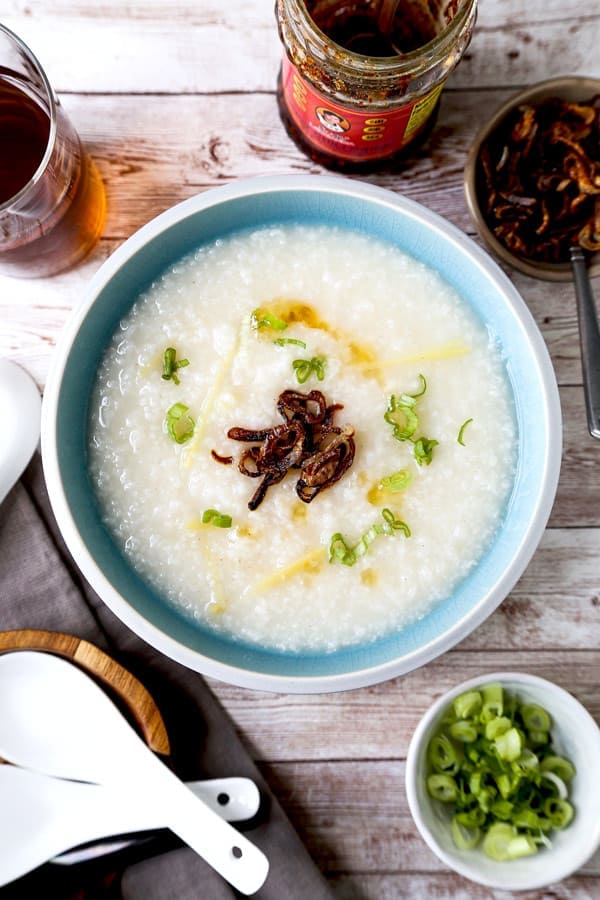
Congee is a thick rice porridge. Simmered in broth or water, the rice grains are essentially overcooked to the point of disintegration. This is what gives congee its smooth, satiny texture.
Eaten as a breakfast food across Asia, this silky, savory rice recipe comes in handy when you need a dose of Mom’s comfort food – or are feeling under the weather. Think of it as a mild meal akin to the chicken soup you might turn to in the West when you’re feeling poorly.
However it can also act as a base for a full meal packed with explosive flavor depending on the ingredients and toppings you use.
Rice porridge goes by a ton of different names throughout the Asian food world – and the regional differences are all wonderful! In China’s Guangdong province, its congee – but in Cambodia its called bobar. Then, Japanese rice porridge is called okayu, while in Korea its jook (or juk).
But, names aside, we’re here to cook and eat right!? So let’s get to it!
The following recipe is for a simple Chinese style rice porridge.

INGREDIENTS FOR CONGEE
- Rice: It always surprises me how such a small amount of rice goes so far when making congee. You’ll only need about a cup to make a full batch. It keeps expanding as it cooks (and we’re basically overcooking it). I like to use medium grain or long grain rice in this Chinese rice porridge recipe.
- Ginger: When making basic congee, using thinly sliced ginger has a twofold purpose. Not only does it deliver a tingling slow burn to the flavor, it also can help settle an upset stomach.
- Chicken Broth or Dashi: This is your cooking liquid. Simmering your rice in low sodium chicken broth will introduce a hearty rich undertone without making the dish overly salty. If you prefer to use dashi (Japanese sea stock), you’ll get an umami, marine base of flavor. Learn how to make dashi from scratch here. Vegans can make a vegetarian congee by using kombu dashi (seaweed dashi). Grab it at your local Asian grocery store – or pick it up on Amazon.
- Kosher Salt: Since kosher salt has larger crystals, it’s harder to oversalt this easy congee recipe than if you used regular iodized salt.
And that’s it! Simple ingredients for the most basic of recipes. Now, you can definitely add more flavor and toppings (more on those in a bit).
Congee can be as simple or as flavor-forward as you choose. Think of it as a blank canvas that you can paint as minimally or as busy as you’d like.
And you won’t believe how easy it is to make at home!
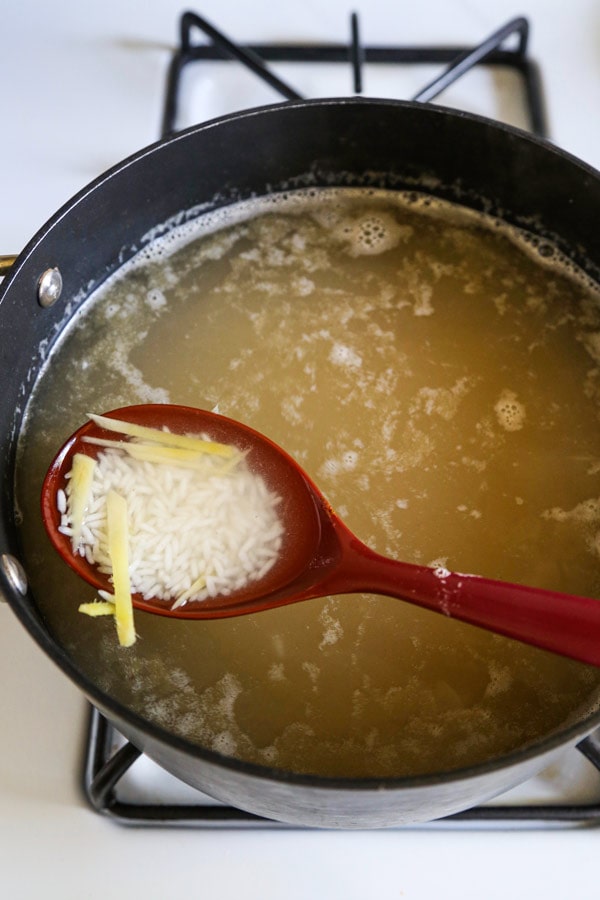
HOW TO MAKE CONGEE
- Rinse your rice in cold water to move excess starch. You may need to rinse and drain your rice multiple times – until the water is clear. Drain well and transfer to a bowl. Fill the bowl with fresh cold water until the rice is submerged and soak for 20 minutes. Then drain the uncooked rice again.
- In a large pot, add the broth (or dashi) and bring to a boil. Add the rice, ginger and salt and stir. Lower the heat to a simmer, cover and cook for 1 hour, stirring once in a while. Add more broth or water if the consistency starts to look too thick.
- Serve with toppings of your choice.
Hey, I told you it was easy!
HOW TO MAKE CONGEE IN A RICE COOKER
Most modern rice cookers are equipped with water fill lines in the inner pot – and automated cooking presets – to make congee with the press of a button. This one even has a Porridge setting.
Your mileage may vary. If you have a classic rice cooker, it may be a bit more difficult to gauge the appropriate cooking time.
However, this is such a rudimentary porridge recipe, you can make it on the stovetop with absolutely no drama.
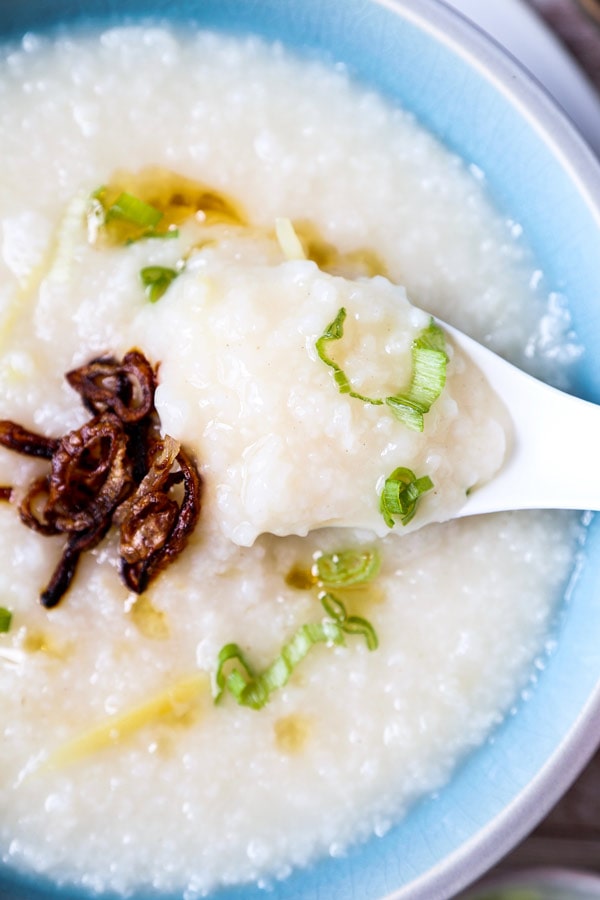
CONGEE TOPPINGS
As I mentioned, the toppings you choose can be as simple or as complex as you’d like. And you can really make a meal out of it!
I’ll never forget the congee Ben made me the last time I was feeling under the weather. He brought me a bowl of basic, plain congee. I said thanks and asked him what he was having for dinner. “Congee,” he said – and returned with his own bowl loaded with an egg, green onions, shallots, tons of chili sauce, cilantro and a few crushed peanuts. I was thankful for my own comfort food (and just a little jealous of his, ha!).
Anyway, here are some of my favorite additions to this basic congee recipe.
- Egg: Make a flavored ramen egg, or a Chinese tea egg – or just a simple poached egg. The creamy yolk in the thick rice porridge is wonderful!
- Chopped Scallions: Garden fresh and crunchy!
- Sesame Oil: Nutty and toasty, sesame oil really latches on to savory flavors. FYI… a little goes a long way!
- Fried Tofu: These are the thin, bean curd pockets sold in the frozen aisle of your local Asian supermarket.
- Chicken: Have leftover roast chicken in the fridge? Heat it up, shred it and OMG, YUM!
- Fried Shallots: These little crispy, sweet and savory fried onions are probably my favorite congee topping of all time!
- Chili Crisp: If you haven’t sampled the wonder of this spicy, salty condiment made with chilies , peppercorns, fried garlic (and absolute magic) – drop everything and pick some up! Once you try it, you’re going to start putting it on everything! Grab it on Amazon.
And that’s just the tip of the iceberg. The sky’s the limit!
What are your favorite congee toppings? Tell me about them in the comments!
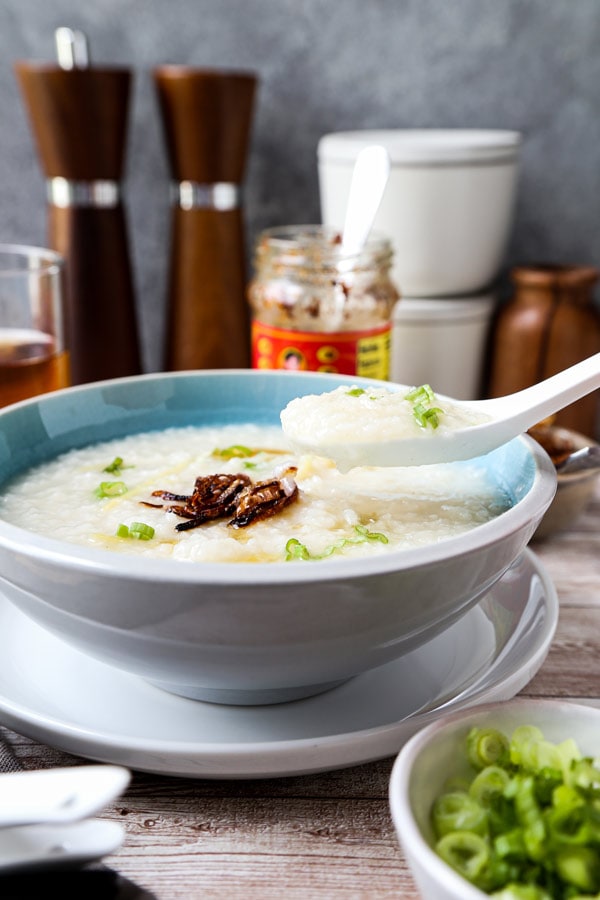
WHAT TO SERVE WITH CONGEE
Now, this totally depends on your reasoning behind eating congee in the first place. If you’re making this soothing Asisn porridge to nurse an upset stomach, you’ll probably want to stick with milder side-dishes – like a few Saltines and maybe a room temperature 7Up. Feel better soo
Pickled Plumn!
댓글
댓글 쓰기